Must You Read Every Word?
A Brief Survey on Sustainable Scholarship
Establishing the habit of writing is difficult, especially when the goal is to produce high-quality articles by entering a conversation (by reading what others say). The intuition (or even what some classes may teach) is that it is essential to read every word of the sources one cites; however, that becomes unmanageable when the goal is to complete a few articles per semester, and each article has at least three books of 500 pages each in its sources. Interestingly, that is not the general academic stance on the matter. In essence, good writers carefully choose what to read, considering variables such as the quality and relevance of the sources or portions of them, the target publication medium, and prior knowledge.
College Guidance
Many undergrads may have experienced being in classes where professors require them to read all sources in full, as in [1, para. 5]. Even some college guides, like in [2], only allow students to read the abstracts or skim during the selection of sources, but they clearly instruct students to read the articles selected thoroughly. It may make sense in specific contexts, like when there are a few short sources (e.g., short articles), when producing a critical analysis of a source, when producing a high-quality publication, or even when learning about a subject. Even then, having ten books of more than 500 pages each would make it impossible, or create considerable overhead, to write an article.
At a professional or graduate level, for example, there is a different mindset. In a Reddit thread titled “Do professional academics read every page of the books they cite?”, there were comments that agreed with being okay with not thoroughly reading the books cited, one even suggesting that their PhD advisor supports it [3] (there is a similar stance in [4]). It makes sense. If a software engineering student were to write about the Agile methodology and found information about it in a chapter of an engineering book, it would be irrelevant to read the section about unit testing versus integration testing processes when the focus of the work is on people’s management.
Additionally, although a few guides expect students to read their sources in their entirety, others emphasize focusing on the topic at hand. One guide from the Academic Resource Center at Harvard University, for example, encourages students to consider factors such as how they will use the text and the type of critical thinking expected of them. They say that “[b]ased on [the] consideration of these factors, [students] may decide to skim the text or focus [their] attention on a particular portion of it” [5]. To put it another way, students must use their critical thinking when deciding what to read.
The same guide by the Academic Resource Center at Harvard University mentions the SQ3R strategy. Fig. 1 shows a diagram of the SQ4R (a variation of the SQ3R) method on a Defiance College webpage, which clearly states that the read step “does not mean reading every word” [6].
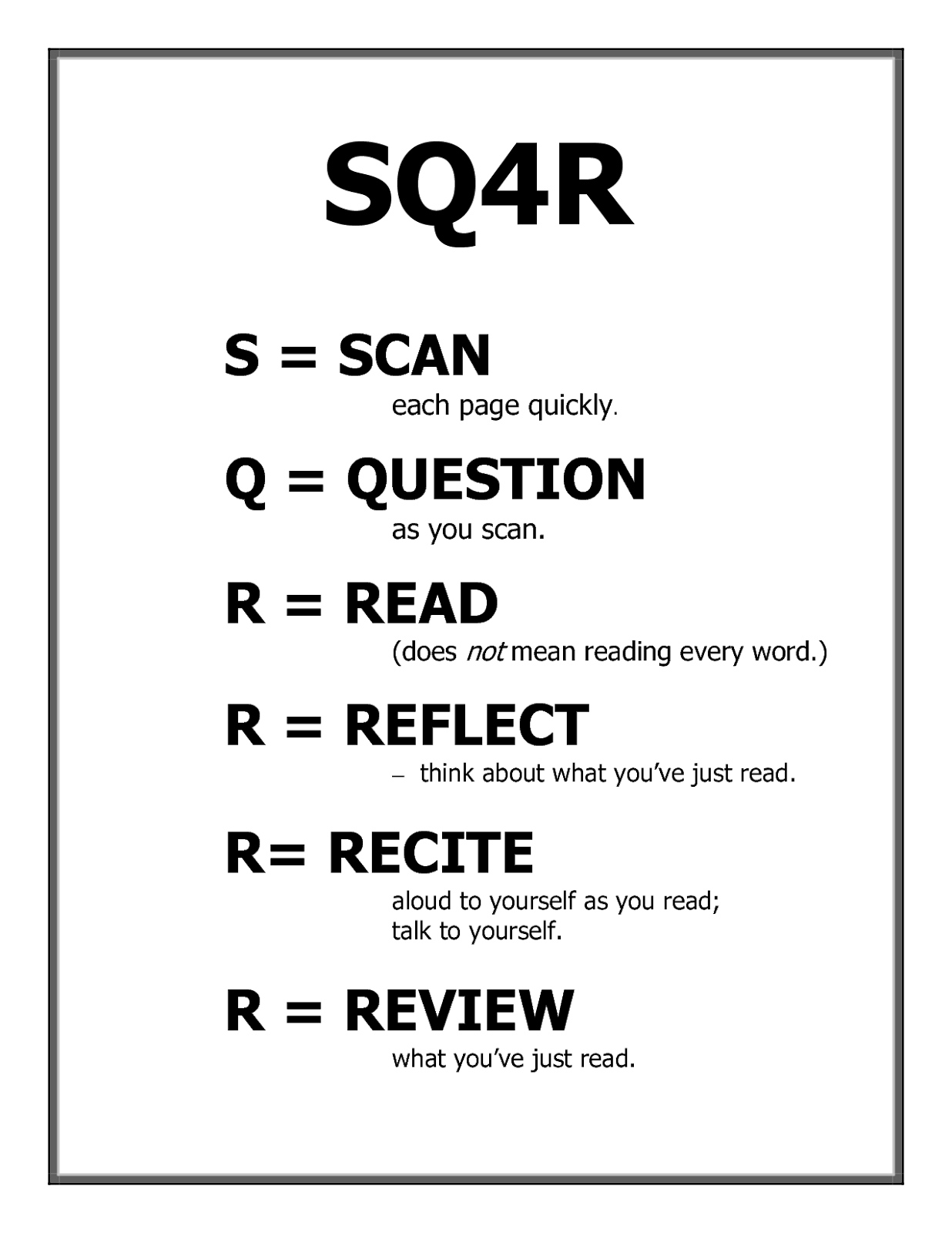
Ultimately, the academic standpoint conveys that selective and strategic reading is a skill; properly navigating sources enables writers to avoid missing relevant evidence and arguments while gaining speed. For students, it is a tool for “evaluating […] sources or identifying information important to [their] work” [7]. Once they have identified the vital pieces, they can read closely and focus on synthesizing information.
Other Interesting Perspectives
Tomasik had other interesting perspectives on the subject, including concepts from economics, the reasoning behind what it means to cite a source, and considerations of the target publication medium.
Drawing a concept from economics, writing about a subject (like opening a factory) has a fixed cost. When learning about the subject, it is best to closely read sources, which allows the writer to get a good sense of the matter. However, as they specialize in a particular area, specific topics will become second nature, and they are highly likely to reuse some sources. In such a case, one can also see the initial reading as an investment [1]. As one specializes in a topic, one also becomes skilled in skimming without losing essential arguments.
Tomasik also cites a discussion from the Academia Stack Exchange. A highlighted argument is that “[w]hen [a writer cites] a source, [they] are not actually claiming that [they] have read it. What [they] are actually doing is staking [their] professional reputation on that source containing the information that [they] claim that it contains.” There is another comment that indirectly builds on that claim, viewing it from an ethical perspective: as long as one clearly conveys the level of work put into verifying claims, sources may make untruthful claims, the writer may be dismissed or proven wrong, but they were ethical about their citations [8]. From a different point of view, that places the responsibility on the reader, but that is probably the best approach since readers always have the responsibility to analyze what they read critically.
Finally, the medium of publication also plays a role. Making a mistake in a personal website is easily fixable. If the writer finds that some information is incorrect, they can update their site. However, it may be challenging to revise a published research paper [1]. In other words, it is more critical to fact-check and read sources for a research paper, and they honestly tend to take longer to produce (sometimes even longer than an academic term).
Conclusions
Becoming a good writer requires being a critical reader and mixing the necessary processes into sustainable habits. It is okay to skip certain sections or to focus on what’s relevant. However, that is a skill readers must develop, and it requires understanding the task at hand and the quality they want to produce; good-quality works require accurate information and are usually a synthesis of various sources (supporting evidence and counterarguments). That requires deep critical reading and effort.
Nonetheless, there are strategies to efficiently produce high-quality articles without burning out. One solution is specialization. As the writer reads (and writes) more about a topic, they will become more familiar with it and can reuse sources they have already read and analyzed in depth. In other words, close reading is also an investment in the bigger picture. In turn, this underscores the importance of incorporating reading (and writing) into one’s habits.
References
- “Should You Read the Whole Article Before Citing It?,” 13 January 2017. [Online]. Available: https://
briantomasik . [Accessed 4 January 2026]..com /read -whole -article -citing/ - “How to Read a Scholarly Article,” Emory Libraries, 1 November 2023. [Online]. Available: http://
guides . [Accessed 5 January 2026]..libraries .emory .edu /c .php ?g=1215922&p=8892938 - “Do professional academics read every page of the books they cite?,” Reddit, [Online]. Available: https://
www . [Accessed 5 January 2026]..reddit .com /r /AskLiteraryStudies /comments /hno5cu /comment /fxcvx4u / - “Do you need to read a whole article before citing it?,” Academia Stack Exchange, [Online]. Available: https://
academia . [Accessed 5 January 2026]..stackexchange .com /questions /28466 /do -you -need -to -read -a -whole -article -before -citing -it /28480#28480 - “Reading,” Academic Resource Center at Harvard University, [Online]. Available: https://
academicresourcecenter . [Accessed 5 January 2026]..harvard .edu /2023 /10 /02 /reading/ - “Reading Strategies: College Reading Resources,” Defiance College, 6 July 2023. [Online]. Available: https://
library . [Accessed 5 January 2026]..defiance .edu /readingstrategies - “Skimming,” The Learning Center, University of North Carolina at Chapel Hill, [Online]. Available: https://
learningcenter . [Accessed 5 January 2026]..unc .edu /tips -and -tools /skimming/ - “Is it unethical to cite a paper or book that you have never looked at?,” Academia Stack Exchange, [Online]. Available: https://
academia . [Accessed 5 January 2026]..stackexchange .com /questions /45295 /is -it -unethical -to -cite -a -paper -or -book -that -you -have -never -looked -at